Factions

HALCYON Dynamics
“Precision is mercy.”
VOLKHOV Response Group (VRG)
“Iron doesn't ask.”
MERIDIAN Security Corporation
“Hold the line.”
HALCYON Dynamics
“Precision is mercy.”
The rich, quiet, sensor-first force. Compute-rich, light on armour, fast on the trigger: every squad has a model in its ear and sees you before you see it. HQ Zürich. Home ground: the Alps and the northern fjord coast. Strongest at range with its sensors up; fragile when the mast falls.
in the sim: damage taken ×1.15 · speed ×1.06 · bleed-out -5 s · rifle →
Origin and home
A Zürich defence-AI house (targeting and sensor-fusion models) that bought a failing Alpine security company the week the Accord passed. HALCYON owns its compute outright: hydro dams, tunnel server halls under the Alps, a fjord chip fab and the northern port that ships its prototypes (Halden Bay, §3). Recruits from the Alpine states, the Nordic coast and the Pacific-rim tech cities: engineers who can fight. Its battlefield model is called WREN; every HALCYON soldier hears it.
Doctrine and how they fight
See first, shoot first. A sensor web of small, many, quiet drones (sparrows) paints the ground; fire teams bound in pairs, mark targets for each other, take the shot from 150–250 m and move before the answer comes. They avoid brawls and win the information fight. When the sensor mast goes down or the jammers come up they are blind, and their light armour shows. In the sim: highest rate of fire and best accuracy, light armour (×1.15 damage taken), +6 % move speed. Vehicles −10 % HP, +10 % speed.
Kit silhouette, colours and camo
- Silhouette: tall and narrow. Full-face visored helmet with a sensor ridge along the crown, smooth rounded plates, low-profile pouches, a compact suppressed rifle with a big optic. Reads at 200 m as a smooth pale head on a slim body.
- Colours: matte grey-white and grey-blue plates (kit tint
#A8B3C7), dark grey soft goods, ice-blue status lights at the visor edge and plate seams (#4FC3DC). - Camo, "Glacier split": hard-edged splinter blocks of pale grey-blue
#B8BFCC, grey-blue#9EA8B8, slate#808C9Eand dark slate#6B788A. Clean, never muddy.
Insignia
A broken ring: a circle open at the top like a sun on the horizon, with a diving chevron (the kingfisher) dropping through the gap. Ice blue on pale grey, cut as a stencil with bridges. Worn as a small shoulder plate and on helmet backs; stencilled on containers and hall doors.
Voice and radio
Calm, low, clipped and procedural; nobody shouts. Bearings in mils or degrees, ranges in metres, WREN's neutral synthetic voice adding confidence figures. Working language English with Swiss-German and Nordic accents.
- "Contact, two-seven-zero, one-forty metres. WREN has them at ninety percent."
- "Sparrows up. Lane is painted. Move on my mark."
- "Mast is dark on the east side. We are blind. Fall back to the hall."
- "Hostile down. Next."
- "Burn-off is ours. Clean work. Keep moving."
Vehicle livery
Two-tone matte grey-white over blue-grey, a thin ice-blue hull stripe and blue running lights, small sans-serif hull numbers, the broken-ring roundel on doors and turret sides. No slogans, no dirt they can help.
Bases
White prefab modules on levelled concrete; server containers in cold-aisle rows with frost on the chillers; sensor masts with dish clusters; blue LED strips and clean cable trays; every door labelled in two languages; HESCO walls wrapped in grey geotextile; racks of sparrows charging in hangar frames.
Fans
The clean shot from 200 metres, and nobody saw where it came from.
Music brief
- Genre: cold electronic: minimal techno and ambient with glassy synths and processed strings.
- Tempo: 118–128 BPM for action; the menu drifts at 80–90.
- Instruments: analog-style synth arpeggios, sub-bass pulses, granular textures, processed string harmonics, crisp electronic percussion, a wordless vocal pad.
- Feel: a precise machine humming in a cold room: clinical, confident, beautiful and a little inhuman. Tension comes from restraint, not volume.
- Cues: menu HAL-MENU "Clean Room" · deploy HAL-DEPLOY "Glass Corridor" · victory HAL-VICTORY "Mercy Protocol".
VOLKHOV Response Group (VRG)
“Iron doesn't ask.”
The steel-rich, compute-poor brawlers. Heavy armour, heavy rounds, big loud drones; they close the distance, kill the sensors and make it a fight. HQ Yekaterinburg. Home ground: the Urals, the steppe and the Caspian shore. Strongest up close and in smoke; slow to get there.
in the sim: damage taken ×0.85 · speed ×0.94 · bleed-out +8 s · rifle →
Origin and home
What was left of three national armies after the Accord's caps, re-flagged as one corporation overnight. VRG owns steelworks, tank plants turned drone works, lithium brine fields and the Caspian power stations; it rents or steals the compute it lacks, which is why it attacks so much. Recruits from the Urals, the steppe, the Caspian and Black Sea shores and the Balkans, and anyone the other two turn away.
Doctrine and how they fight
Close the distance. Kill the sensors. Make it a brawl. Squads move as blocks behind smoke, LMG-heavy, and go for the enemy's counter-drone battery and sensor mast first. Their drones (hammers) are few, big, armoured and loud, more flying tanks than birds. They accept losses and out-last you; a VRG soldier who is down is only resting. In the sim: hardest-hitting rifle, slowest fire, heavy armour (×0.85 damage taken), −6 % move speed, longer bleed-out. Vehicles +10 % HP, −10 % speed, main gun ×1.1.
Kit silhouette, colours and camo
- Silhouette: wide and heavy. A rebreather with twin filter cans gives the head a snout; welded steel plate over a padded jacket; a helmet with a bolted visor plate; exposed cabling, mismatched pouches, numbers painted on the guns. Reads at 200 m as a broad dark block with a square head.
- Colours: dark olive-rust (kit tint
#454A33), black webbing, oxide red#B5532Afor painted numbers and slogans. - Camo, "Slag": broad brush-painted patches of dark olive
#21240F, rust brown#33291C, earth black#171A12and umber#403524. Repainted in the field; never quite matches.
Insignia
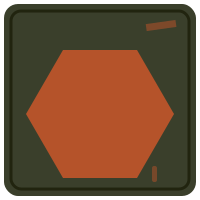
A hex nut (a bolt head) with a heavy V notched out of its top edge, solid and blunt. Oxide red on dark olive, usually hand-sprayed through a cut stencil so the bridges show and the paint runs.
Voice and radio
Loud, rough and short, over a net full of jamming hiss. Orders barked once; gallows humour on the open channel. Working language a clipped field English with Ural and steppe accents; counts in a slow cadence.
- "Hammer is up. Everybody down, it comes in loud."
- "Their mast is still standing. Somebody put iron through it."
- "Smoke, smoke! Second squad, through the gap. Go!"
- "Medic! He is breathing, he is just stupid. Pick him up."
- "Hall is burning. Good. Now hold it."
Vehicle livery
Dark olive with brushed rust patches, big hand-painted oxide-red hull numbers, white stencilled slogans on the skirts (IRON DOESN'T ASK), welded slat armour and mismatched replacement panels.
Bases
Converted heavy industry: turbine halls, rail sheds and slag heaps; concrete revetments and scrap-metal walls; old transformers; cables run along the ground; sodium lights, burn barrels, tarps, painted slogans; diesel generators thumping all night.
Fans
Kick the door, eat the hits, stand on the objective when the smoke clears.
Music brief
- Genre: industrial metal and heavy industrial, with a folk-drone undertow.
- Tempo: 70–100 BPM half-time groove; deploy may double to 140.
- Instruments: down-tuned baritone guitars, struck steel and chains as percussion, big low drums, distorted bass, a wordless low male choir, a reed-organ drone, field-recorded machinery.
- Feel: a steelworks at night: furnaces, hammers, a crowd chanting under the noise. Weight over speed.
- Cues: menu VRG-MENU "Slag Heap" · deploy VRG-DEPLOY "Iron Weather" · victory VRG-VICTORY "Furnace Song".
MERIDIAN Security Corporation
“Hold the line.”
The regular army. By the book, combined arms, logistics first; nothing special alone, very hard to beat when the trucks arrive. HQ Anchorage. Home ground: the boreal north, its rail yards, ports and arctic fab.
in the sim: damage taken ×1 · speed ×1 · bleed-out +0 s · rifle →
Origin and home
Spun out of a defence ministry's own logistics contractor the year the Accord passed; most of its officers were in uniform the year before. MERIDIAN owns airfields, rail lines and ports across the far north, an arctic chip fab on a pipeline terminal (Alyeska Terminus, §3) and the relay chain that runs down the rail country (Kennick, §3). Recruits ex-regulars from a dozen disbanded armies around the North Atlantic and the Pacific north-west.
Doctrine and how they fight
Take it, dig in, hold it. Bounding overwatch by the book, fire and manoeuvre, squads that ride trucks and APCs to the line, call for fire, then rotate and hold what they took. Forward spawns and supply are their weapon. One standard-issue drone per platoon (the sentry), always there. In the sim: the baseline. Middle rate of fire, middle damage, normal armour and speed; vehicles are the reference.
Kit silhouette, colours and camo
- Silhouette: the classic modern soldier. Helmet with a fabric cover and night-vision mount, plate carrier with pouches, knee pads, a radio whip antenna, a small assault pack. Reads at 200 m as "a soldier" with an aerial.
- Colours: tan and green (kit tint
#998F6B), coyote soft goods, a signal-blue ID patch on the shoulder (#2F6FB2). - Camo, "Taiga": a soft multi-colour pattern of tan
#A89A72, olive#6E6B48, brown#5A4A34and sage#8C9278. Clean but worn.
Insignia
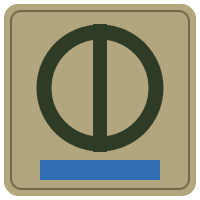
A globe cut by one vertical meridian line, with a heavy horizontal bar beneath it: the meridian and the line. Dark green on tan with the bar in signal blue; stencil-cut with bridges. Worn as the blue shoulder patch and painted on vehicles and container doors.
Voice and radio
Proper radio procedure: callsigns, prowords, calm NCO voices, dry humour. North Atlantic and Pacific accents.
- "Bravo Two-One, contact front, two hundred, infantry in the treeline. Engaging."
- "Truck's up. Second squad, mount up, we move in thirty."
- "Objective Charlie secure. Dig in. Set the line."
- "Say again your last, you are breaking up. Over."
- "Mortar battery is down. We have lost fires. Push the bunkers on foot."
Vehicle livery
Matte olive drab with tan disruptive bands, white hull numbers and unit codes, a signal-blue recognition panel on the roof, the globe roundel on the doors. Clean, then mud to the axles.
Bases
Proper forward operating bases: HESCO rows and sandbagged gun pits, shipping-container data centres with chillers on the roofs, motor pools with fuel bladders, rail spurs, signposts with unit names, the company flag on a pole (never a national one), floodlights, camouflage netting.
Fans
The plan worked because everyone did their job: the truck showed up and the line held.
Music brief
- Genre: modern cinematic orchestral hybrid, a military score.
- Tempo: 100–120 BPM.
- Instruments: snare cadences, low brass and horns, string ostinatos, timpani, an electric guitar texture, warm synth pads.
- Feel: a disciplined column moving at dawn: steady, determined, weathered, hopeful at the top. Never triumphant until it has earned it.
- Cues: menu MER-MENU "Long Watch" · deploy MER-DEPLOY "Column Forward" · victory MER-VICTORY "The Line Held".
Side by side
| HALCYON | VRG | MERIDIAN | |
|---|---|---|---|
| Motto | Precision is mercy. | Iron doesn't ask. | Hold the line. |
| HQ / home ground | Zürich / Alps, fjord coast | Yekaterinburg / Urals, steppe, Caspian | Anchorage / boreal north, rail, ports |
| Runs on | compute | steel | logistics |
| Drones | sparrows: small, many, quiet | hammers: big, few, loud | sentries: one per platoon |
| Silhouette | tall, narrow, smooth visor | wide, heavy, rebreather snout | classic soldier, antenna |
| Kit colour | grey-white / grey-blue, ice-blue lights | dark olive-rust, oxide red | tan / green, signal-blue patch |
| Camo | Glacier split | Slag | Taiga |
| Insignia | broken ring, diving chevron | hex nut, notched V | globe, meridian, bar |
| Radio | quiet, numbers, WREN | loud, short, jammed | callsigns and prowords |
| Music | cold electronic | industrial metal | orchestral hybrid |
| Fans | the clean shot | the brawl | the plan |
The emblems are stencils drawn for the wiki (site/wiki/img/lore/emblem-*.svg) in the kit colours of client/scripts/soldier.gd; the bridges in each one are the stencil's ties. Source: LORE.md §2.